

We’ve posted a lot about fall gardening on Instagram recently, and we’ve gotten some thoughtful questions about how our garden advice applies to fall plants in smaller containers or directly planted in the ground. Although raised beds are certainly our jam, the difference in growing plants in raised beds, container, or in the ground really matters in the fall, and it can be helpful to dive deeper. All three approaches can produce a beautiful crop of lettuce, kale, carrots, herbs and other cool-season vegetables. But the soil around those plants behaves differently depending on how much of it there is—and how exposed it is to the air around it.
Here’s what to keep in mind:
Soil Temperature
Think about a little pot sitting on your patio. Almost the entire root zone is surrounded by air. When the afternoon is warm, that soil heats up quickly. When we get a chilly October night, it cools down quickly too. A raised bed does the same thing, but it’s a little less dramatic. Because the soil sits above ground level and the sides of the bed are exposed, raised beds tend to respond more quickly to changes in air temperature.
That can be wonderful in early spring, when we are impatiently waiting for cold soil to warm up. In fall, however, it works in the opposite direction: raised beds also lose heat more quickly as our nights get colder.
In-ground soil has much more thermal mass around it. The earth acts like insulation, so the temperature several inches below the surface changes much more gradually.
In some ways, the cooler soil can benefit gardeners who grow in raised beds. When you’re ready to plant spinach seeds, for instance, the seeds have a higher likelihood of germinating if the soil is between 55-68°. We middle Tennesseans are high above that temperature range right now, and I’m not expecting any sprouts from spinach seeds for a while. When our days finally cool off, the soil temps in raised beds will reflect that much faster than the ground will. It follows then— spinach seeds will germinate more quickly in a pot or raised bed, and may take another week or so in the ground.
On the other hand, when Nashville finally experiences our first freeze, the tomatoes and peppers will immediately suffer in the containers and raised beds since the soil temperature will drop dramatically too. The plants that are growing in the ground, however, can withstand a frosty night since the soil is still warm enough to protect them.
In summary, the larger the raised bed or container, the more stable its temperature will usually be. If you are wanting to protect warm season crops as long as you can this October and November, the ground will stay warmer longer. If you need cooler soil for cool season plants, however, raised beds have that advantage.
Soil Fertility
Here is one place where raised beds and containers have a major advantage: we get to decide exactly what goes into them.
If you've ever tried to dig a hole in Middle Tennessee clay, you understand the appeal.
A raised bed filled with a good blend of soil and compost gives us a loose, biologically active growing medium without spending years trying to improve the native soil underneath it. UT Extension also notes that one of the advantages of raised beds is reduced soil compaction, because we're not walking through the growing area. I love not having to battle Bermuda grass.
But there's a catch.
That beautiful soil isn't a permanent bank account. Every crop removes nutrients. Organic matter decomposes. Water carries some soluble nutrients deeper into the soil profile and, in a container, eventually right out the drainage hole. The smaller the volume of soil, the less margin for error we have. A small container may need regular additions of compost or fertilizer because a hungry vegetable plant is pulling nutrients from a very limited reservoir. A large raised bed has considerably more buffering capacity, but I still like to replenish our beds with compost between major growing seasons.
An in-ground garden can have an enormous reservoir of nutrients—but only if the soil is healthy in the first place. Native soil may be fertile, poor, compacted, acidic or somewhere in between. This is where a soil test becomes much more valuable than guessing.
So if I had to simplify it:
Small container: easiest soil to control, but easiest to deplete.
Raised bed: lots of control with a much larger nutrient reservoir.
In-ground: potentially the largest reservoir of all, but you're working with the soil nature gave you.
Water Retention
This may be the difference you notice most.
When we build a raised garden bed, one of our goals is excellent drainage. Water should be able to move through the soil rather than sitting around vegetable roots.That is exactly what we want. But good drainage means we also have to pay attention to moisture. A raised bed has more surface area exposed to air, and excess water can move down through the soil profile. During hot, windy stretches, raised beds can dry noticeably faster than the surrounding ground.
Small containers amplify this problem. There simply isn't very much soil available to hold water. A pot that was perfectly moist yesterday can be surprisingly dry today. In-ground gardens are generally more buffered. Moisture from deeper soil can remain available to roots, and the surrounding earth isn't exposed to drying air on five sides the way a pot is.
This becomes interesting in fall because our watering habits need to change.
September in Tennessee can still feel like August. Your new lettuce seedlings may need very regular water while they're establishing. But by late October, temperatures are cooler, evaporation slows and plants are growing more slowly. The same bed that needed frequent irrigation several weeks earlier may suddenly stay moist for days. This is why I would rather teach someone to stick a finger into the soil than tell them to water for thirty minutes every day. Plants don't own calendars.
So Which Should You Choose?
Honestly, use the space you have. If you have a sunny patio, grow lettuce in pots. If you have raised beds, fill them with kale, carrots, spinach and herbs.If you have good in-ground soil, take advantage of the temperature and moisture stability that the earth provides.
The real trick isn't choosing the “perfect” method. It's understanding the little ecosystem you've created around your plant roots. A small container changes quickly. A raised bed sits somewhere in the middle. The ground changes slowly. And in fall, when temperatures, rainfall and daylight are changing around us almost every week, those differences become much easier to see.
Our new garden care coach, Ethan, created a table for us to sum all of this up. If you meet him, just ask him to pronounce and define “Monoecious.” You might just be fascinated.
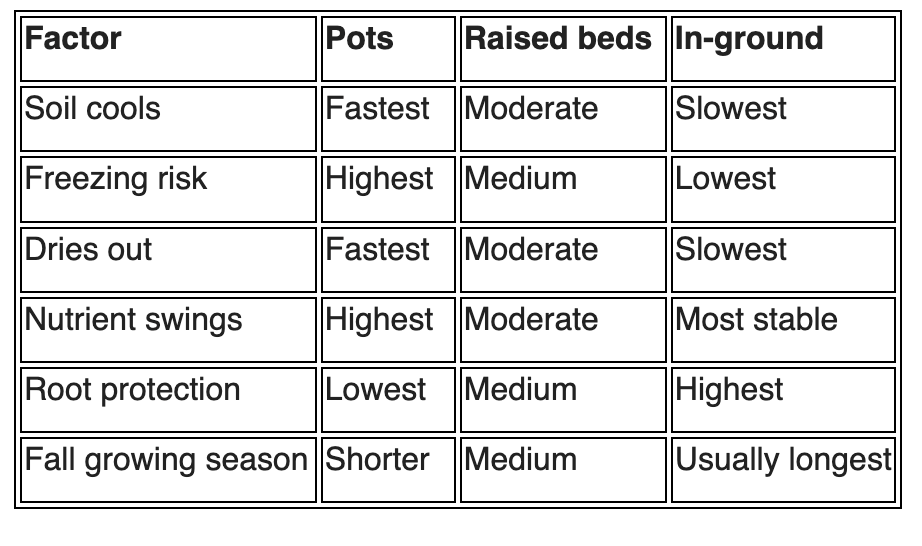
Ethan’s chart comparing important factors of growing in the ground, in containers, and in raised beds.
